Investor Alert:
CIRO is warning Canadian investors about fraudulent emails impersonating Interactive Brokers Canada Inc. (IBKR), a CIRO member.



Comments Due By: September 28, 2026
The Canadian Investment Regulatory Organization (CIRO) is proposing a new Crypto Fee Model designed to recover crypto surveillance regulatory costs through an activity‑based approach. The following materials are provided for consultation and comment:
CIRO is proposing that the new Crypto Fee Model be effective on July 1, 2027.
Investor interest in crypto assets and the use of Crypto Trading Platforms (CTPs) have increased significantly in Canada. In response, the Canadian Securities Administrators (CSA) and CIRO have taken a phased approach to clarify how existing securities regulatory frameworks apply to CTPs. This included a joint consultation in 2019 and the publication of Joint guidance in 2021 from CSA and IIROC (Staff Notice 21 – 329) outlining regulatory expectations to address key risks such as custody, market integrity, conflicts of interest, and operational resiliency.
Due to the growing interest from Members seeking to offer crypto asset trading for their clients, CIRO has approved certain Dealer and Marketplace Members to offer trading in crypto assets. As crypto‑related activity and oversight requirements have expanded, CIRO has introduced fixed interim fees to recover increased direct CTP oversight costs. These fees will apply until June 30, 2027, bridging to the implementation of the proposed Crypto Fee Model on July 1, 2027.
Effective July 1, 2027, and in accordance with the CSA Recognition Orders and CIRO’s Guiding Principles (outlined below), CIRO intends to implement the proposed Crypto Fee Model to recover CTP surveillance costs using an activity-based cost allocation methodology. From July 1, 2027, to March 31, 2028, cost recovery will be based on direct costs only. Beginning April 1, 2028, CIRO will transition to full cost recovery as the majority of Members are expected to be registered by that time.
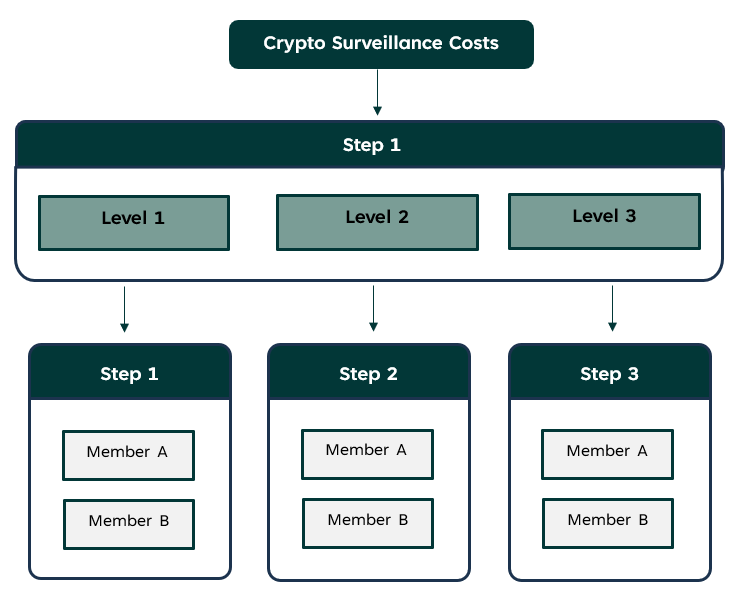
Under the proposed Crypto Fee Model, costs are allocated using a two-step process. Total surveillance costs are first distributed across Levels based on relative supervisory effort and then further allocated to individual Members based on their trading activity.
The model separates Members into one of three Levels based on unique surveillance requirements:
All Members would be subject to an annual minimum fee, ranging from $50,000 to $100,000 depending on Level, with transitional relief available for certain new Level 1 Members.
In the development and evaluation of the proposed Crypto Fee Model, CIRO has applied the following Guiding Principles per CSA Recognition Orders:
The proposed Crypto Fee Model was presented to the CIRO Board on June 17, 2026, where it was approved for publication for comment.
Members may request an estimate of their applicable fees by submitting their 12‑month crypto trading volume for the period from June 2025 to July 2026. Submissions must be received no later than August 14, 2026, which is 15 days from the publication date of this Bulletin.
Fee estimates will be provided in early September and delivered directly to the submitting Member. Trading volume information should be submitted to the Membership Services mailbox listed below.
Comments should be in writing and delivered by September 28, 2026 (60 days from the publication date of this Bulletin) to:
Membership Services
Canadian Investment Regulatory Organization
40 Temperance Street, Suite 2600
Toronto, Ontario M5H 0B4
e-mail: [email protected]
A copy should also be delivered to the CSA:
Trading and Markets
Ontario Securities Commission
20 Queen Street West
22nd Floor
Toronto, Ontario M5H 3S8
e-mail: [email protected]
and
Market Oversight
Alberta Securities Commission
Suite 600 250-5th Street SW
Calgary, Alberta T2P 0R4
email: [email protected]
Commentators should be aware that a copy of their comment letter will be made publicly available on the CIRO website at www.ciro.ca.
After considering the comments received, together with any additional comments from the CSA, CIRO staff may recommend revisions to the Crypto Fee Model. If the comments received are not material in nature, the Board has authorized CIRO’s President to approve the revisions, subject to final approval by the CSA. If the comments are material, CIRO staff will submit the revised Crypto Fee Model to the Board for approval for republication or implementation, as applicable.
Since the creation of Bitcoin in 2008, investor interest in crypto assets has grown significantly. This growth has been accompanied by the emergence and expansion of CTPs, which facilitate the trading of crypto assets by retail and institutional investors.
In response to these developments, Canadian securities regulators and self‑regulatory organizations began to consider how existing securities regulatory frameworks should apply to CTPs. On March 14, 2019, the CSA and IIROC published Joint Consultation Paper 21‑402, Proposed Framework for Crypto‑Asset Trading Platforms, which sought public comment on a regulatory framework for platforms trading crypto assets.
Building on feedback received through this consultation process, on March 29, 2021 the CSA and IIROC published Joint Staff Notice 21‑329, Guidance for Crypto‑Asset Trading Platforms: Compliance with Regulatory Requirements, which provided guidance on how Canadian securities legislation applies to CTPs and outlined regulatory expectations for platforms offering crypto asset trading services to Canadian clients.
These regulatory initiatives were intended to balance support for innovation in the Canadian capital markets with the need to protect investors and promote fair and efficient markets, given the unique risks associated with CTPs, including custody, market integrity, conflicts of interest, and operational resiliency.
Since the publication of this guidance, CIRO, as successor to IIROC, has received a growing number of applications from both prospective and existing Dealer and Marketplace Members seeking to offer access to crypto assets to their clients.
In December 2022 and December 2024, CIRO entered into RSAs with Coinsquare Capital Markets Ltd. and NDAX Canada Inc., respectively, both of which are Marketplace Members operating CTPs. Under these agreements, CIRO charged a monthly fee to recover direct costs related to crypto market surveillance.
As CTP activity and membership grew, CIRO implemented an interim fee effective April 1, 2026 to recover direct crypto‑related oversight costs across all CIRO Members engaged in crypto trading. These interim fees will apply from April 1, 2026 to June 30, 2027, bridging the period until the Crypto Fee Model takes effect on July 1, 2027. The interim CTP fees are set at the same amount as the minimum fees under the Crypto Fee Model.
CIRO has made targeted investments and established dedicated resources to support the effective oversight of crypto trading activities. These investments were required to respond to the growth, complexity, and risk profile of crypto‑related business conducted by regulated Members, and to ensure that CIRO continues to meet its mandate to protect investors and promote fair and efficient capital markets.
As these supervisory capabilities are focused on Members engaging in crypto trading activities, it is appropriate for CIRO to begin recovering the associated costs from those Members that directly benefit from these regulatory functions. This helps ensure that the broader membership does not disproportionately subsidize oversight activities that are specific to CTP Members.
Under the Crypto Fee Model, each Member’s annual fee is determined through an activity‑based allocation of CIRO’s total crypto surveillance costs across Levels and participating Members.
Given the evolving nature of the crypto environment, the following guidance outlines the different Levels for the purposes of cost-recovery applicable to CTPs. CIRO will assign each CTP to the appropriate Level based on its assessment of surveillance effort required. A CTP’s Level assignment may be updated over time to ensure that surveillance requirements remain appropriately aligned with the member’s activities.
CTP Members are approved to trade instruments that are subject to surveillance by the CIRO Crypto surveillance team.
| Level | Guidance | CIRO’s Surveillance Activity |
|---|---|---|
| Level 1 | CTP Members within this Level generally:
| Trades – Executions |
| Level 2 | CTP Members within this Level generally:
| Trades+ – Canadian executions only, with additional data context requiring extra review |
| Level 3 | CTP Members within this Level generally:
| Trades + Orders – Messages |
Please refer to Schedule A for the illustration of cost allocation as outlined above.
All Members are subject to an annual minimum fee, as outlined below:
| Level | Proposed Annual Minimum Fee |
|---|---|
| Level 1 | $50,000* |
| Level 2 | $100,000 |
| Level 3 | $100,000 |
* Within Level 1, a reduced annual Bridging Fee of $25,000 applies during the first fiscal year of membership for new Members with less than 100,000 trades in the 12 months preceding onboarding.
The minimum fees are established to be consistent with the interim fees to cost recover on a significant portion of the fixed costs. Given the current small and dynamic population of Members, this approach lowers the volatility of Member fees to changes in membership base. Additionally, the Bridging Fee has been included to support affordability and reduce barriers to entry.
As CIRO has begun to incur incremental costs to support effective regulatory oversight of CTPs, it has introduced an interim cost recovery mechanism effective April 1, 2026. This interim approach is intentionally limited in scope and focused solely on the recovery of direct costs, rather than full cost recovery. The interim fees are set consistent with the minimum fees above, providing continuity and predictability as CIRO transitions to the Crypto Fee Model.
In the first year of implementing the Crypto Fee Model, CIRO proposes to continue the transitionary measures and recover for direct costs only. This phased implementation is intended to cover the transitional period before the majority of Members are expected to be registered and enable proportionate cost recovery among Members.
Please refer to Schedule B for a summary chart outlining the applicable timelines.
CIRO conducted a comprehensive analysis of the impact upon Members under the Crypto Fee Model reflecting potential variations in Member composition. The Crypto Fee Model is intended to apply uniformly and does not have regional impacts. Given uncertainty around costs, Member composition, transaction volumes, and the dynamic nature of the CTP environment, the analysis and estimates presented are illustrative and intended to be directional in nature.
Illustrative fee range by Level for full cost-recovery (starting April 1, 2028):
| Level | Small Member1 | Medium Member | Large Member |
|---|---|---|---|
| Level 1 | $50,000 | $50,000 - $75,000 | $75,000 - $125,000 |
| Level 2 | $100,000 | $100,000 - $175,000 | $175,000 - $250,000 |
| Level 3 | $100,000 | $100,000 - $200,000 | $200,000 - $300,000 |
As noted in the transitionary measures, cost recovery under the proposed CTP Fee Model up to March 31, 2028 will be based on direct costs only. Accordingly, during this transitionary period, Members should generally expect fees to be at or close to minimum fees. Large Members may incur fees above the minimum, reflecting higher volumes of activity and associated oversight requirements.
Key assumptions of this analysis include:
Trade-Weight Multipliers: Total surveillance costs are allocated to Levels based on weighted trade volumes. The trade‑volume weightings assume differing levels of surveillance effort, informed by management judgment, resource consumption, and risk. For the illustrative analysis above, the following trade‑weight multipliers have been applied based on current expectations:
The trade‑volume weightings will be reviewed annually as part of CIRO’s budget and fee‑setting process and may be adjusted as necessary to reflect changes in market activity, industry growth, and evolving surveillance requirements. The annual review will ensure that cost allocation remains appropriately aligned with surveillance needs over time.
During the Public Comment period, Members are encouraged to request fee estimates by submitting their 12‑month crypto trading volume for the period from June 2025 to July 2026. Submissions must be received no later than August 14, 2026, which is 15 days from the publication date of this Bulletin.
In determining the methodology for recovering the incremental costs associated with crypto surveillance, CIRO considered the following alternative approaches:
To ensure that Member perspectives were appropriately considered in the development of the Crypto Fee Model, CIRO engaged an industry working group in January 2025 representing a diverse range and of CTP’s, including both large and small Members. Feedback from this engagement was used to inform and refine elements of the Crypto Fee Model and was generally supportive of the proposed activity-based cost recovery mechanism and minimum fee structure. Questions raised were primarily clarificatory, focusing on implementation timing and the classification of categories, and have been addressed through updates to the Crypto Fee Model and the accompanying FAQs.
The Crypto Fee Model applies similar transaction‑based regulatory fees, such as FINRA’s Trading Activity Fee and CIRO’s Equity Market Trade Fee and Debt Market Transaction Fee, which have long been used to recover the costs associated with market surveillance and enforcement in securities markets.
Overall, the Crypto Fee Model meets the Guiding Principles:
Two-Step allocation methodology:
| Effective Period: | Cost Recovery Method: | Costs Recovered: | Fee Basis: |
|---|---|---|---|
| Apr 1, 2026 – Jun 30, 2027 | Interim CTP Fees | Direct Costs | Fixed (Minimum Fees) |
| Jul 1, 2027 – Mar 31, 2028 | Proposed CTP Fee Model | Direct Costs | Activity-Based |
| Apr 1, 2028 onward | Proposed CTP Fee Model | Full Costs | Activity-Based |
Appendix A – Integrated Fee Model – blacklined
Appendix B – Integrated Fee Model – clean
Appendix C – Frequently Asked Questions (FAQs)
1. Why is CIRO introducing a separate cost recovery model for crypto surveillance?
This model reflects the distinct surveillance demands associated with crypto markets, including 24/7 trading, fragmented liquidity, and cross-platform activity. These are real costs that CIRO is already incurring and will continue to incur as the market evolves. Rather than distributing those costs across all Members, the model is designed to ensure they are borne by those Members whose activities give rise to them. This approach reflects a fundamental principle of cost recovery: that regulatory costs are allocated in a way that is fair, proportionate, and aligned with the activities that generate them.
2. Why are crypto Dealers paying both annual Dealer Fees and separate CTP Regulation Fees if they do not operate Marketplaces?
The two Fee Models are designed to recover different types of regulatory costs:
3. How will CIRO determine whether a Member is classified as a Level 1, Level 2, or Level 3 member?
Classification will be based on the firm’s functional role in the market, and categories of registration.
4. Why should a Level 1 Member that routes orders to a global Marketplace bear surveillance costs if it does not control or operate the Marketplace?
Even where execution occurs externally, the Member facilitates access to that Marketplace and may introduce risks related to client activity, order flow, and market integrity. Surveillance obligations and associated costs reflect that role in enabling participation.
5. If an unrelated Dealer Member conducts its trades on a Marketplace, will those entities pay fees for the same transaction?
Marketplaces and Dealer Members are both charged because CIRO reviews different activities for each. As business models evolve, CIRO will adjust to ensure cost recovery is fair.
6. Why does the proposed Fee Model weight trades between Level 1, Level 2, and Level 3 members differently?
Costs are allocated proportionately based on the level of surveillance effort and regulatory risk associated with each Level. Weightings are determined by management based on factors such as trading volume and frequency, complexity of trading activity, and the expected level of surveillance work (e.g., alerts, monitoring, and follow‑up analysis). This also includes consideration of the associated regulatory risk, including the likelihood and potential impact of market conduct issues. Based on these factors, a higher weighting is assigned for both Level 2 and 3:
7. How would surveillance costs of tokenized securities be allocated? Would trading in tokenized equities fall under the CTP Regulation Fee Model or the Equity Market Regulation Fee Model?
CIRO would need to look at the substance of the product. If the tokenized instrument behaves like an equity and is traded in a manner consistent with equity markets, it would generally fall within the Equity Market framework.
Alternatively, if the trading environment introduces crypto-like features that materially affect surveillance complexity, CIRO may need to establish a surveillance approach distinct from equity and fixed income frameworks, and the cost recovery model would need to reflect those additional considerations. The framework is intended to be flexible to ensure alignment with actual regulatory effort.
Given the evolving nature of tokenization and the associated surveillance requirements, CIRO has not made a determination at this time. Any future decision will depend on the materiality of the issue and the applicable surveillance structure, and will be reassessed as appropriate.
8. Should implementation of the Fee Model be delayed until full membership is in place (expected by April 1, 2028, two years after the CSA’s last decision)?
To account for the possible limited membership prior to April 1, 2028, CIRO will only recover direct costs until April 1, 2028. CIRO will continue working with the CSA to ensure the majority of restricted Dealers are registered by April 1, 2028 and to limit exemptions. In the event of any material delays, we will provide advance notice prior to implementation.
9. How transparent will CIRO be about how these costs are calculated?
CIRO will provide transparency around methodology and inputs used to determine fees, enabling firms to understand their allocations and plan accordingly. The methodology will be published on CIRO’s website along with CIRO’s other Fee Models. Total costs and costs recovered will be disclosed as part of our annual financial statements along with CIRO’s other Fee Models. As part of the quarterly billing process, Members will receive detailed information on the calculation, including trading volumes and the applicable cost‑recovery rates (expressed as dollars per trade or message). The rate is a function of the total costs to be recovered, weighting for each Level, as well as participating Members and their respective trades/messages.
07/30/26
26-0163
Welcome to CIRO.ca!
You can find the Canadian Investment Regulatory Organization (CIRO) at CIRO.ca with our fresh look and feel.