


Contact
Executive Summary
Comments Due By: November 12, 2026
The Canadian Investment Regulatory Organization (CIRO) is proposing to apply volatility controls to extended trading hours. The Guidance on Marketplace Thresholds and the Guidance on Single-Stock Circuit Breakers (together as the Proposed Guidance) have been updated to clarify how these controls would operate outside of core trading hours (i.e. 9:30 a.m. to 4:00 p.m. ET), including periods where there may be limited trading activity. The proposed changes are intended to support consistent application of volatility controls across all marketplaces for which CIRO acts as the regulation services provider, helping to prevent erroneous orders and short-term price volatility and to maintain fair and orderly markets.
How to Submit Comments
Comments on the Proposed Guidance should be in writing and delivered by November 12, 2026 (30 days from the publication date of this Bulletin) to:
Market Regulation Policy
Canadian Investment Regulatory Organization
Suite 2600
40 Temperance Street
Toronto, Ontario M5H 0B4
e-mail: [email protected]
A copy should also be delivered to the Canadian Securities Administrators (CSA):
Trading and Markets
Ontario Securities Commission
Suite 2200
20 Queen Street West Toronto, Ontario M5H 3S8
e-mail: [email protected]
Market Oversight
Alberta Securities Commission
Suite 600
250-5th Street SW, Calgary, Alberta, T2P 0R4
e-mail: [email protected]
Commentators should be aware that a copy of their comment letter will be made publicly available on the CIRO website at www.ciro.ca.
1. Background
Marketplace Thresholds and Single Stock Circuit Breakers (SSCBs) form part of CIRO’s multi-tiered framework of controls to mitigate the risks associated with short-term, unexplained price volatility and promote fair and orderly markets.
Marketplace Thresholds are prescribed price parameters that prevent the execution of an incoming order that would trade at a price outside an acceptable range for a security. They operate as a pre-trade control by requiring marketplaces to measure incoming orders against specified reference prices and prevent execution where the order would exceed the applicable threshold level. Marketplace Thresholds currently apply during core trading hours of 9:30 a.m. to 4:00 p.m. ET.
SSCBs are temporary trading halts that apply to certain listed securities that experience sudden and significant price movements over a short period of time. They are intended to mitigate unexplained short‑term volatility by providing a brief pause in trading of a security when predetermined price movement thresholds are reached. SSCBs currently apply from 9:30 a.m. to 3:30 p.m. ET.
All rule references in the Proposed Guidance are to UMIR unless otherwise specified.
2. Proposed Guidance
Given that Marketplace Thresholds and SSCBs are intended to operate together as part of CIRO’s multi-tiered volatility control framework, CIRO is proposing updates to both Guidance to address the application of these controls during extended trading hours.
For the purposes of the Proposed Guidance, extended trading hours refer to trading that occurs between 7:00 a.m. and 9:30 a.m., and between 4:00 p.m. and 8:00 p.m. ET. If in the future, a marketplace is approved to operate before 7:00 a.m. ET or after 8:00 p.m. ET, CIRO would review the volatility controls framework as a whole, including market wide circuit breakers, to determine whether further changes are necessary at that time.
2.1 Marketplace Thresholds
CIRO is proposing updates to the Guidance on Marketplace Thresholds to address how marketplace thresholds would operate during extended trading hours. Specifically, the proposed updates would:
- extend the time period when Marketplace Thresholds would apply to include from 7:00 a.m. to 9:30 a.m. ET and from 4:00 p.m. to 8:00 p.m. ET
- require marketplaces to reset the One-Minute Reference Price to match the opening price on the Primary Listing Exchange1 once the opening trade has occurred
- clarify the operation of Marketplace Thresholds during periods of limited trading activity.
CIRO is not proposing changes to the current price parameters for Marketplace Thresholds as part of this proposal. Given the lack of data on trading activity during the new extended trading hours, CIRO believes it would be appropriate to proceed on a phased basis. Under this approach, CIRO would assess the operation of Marketplace Thresholds during the initial implementation phase before determining whether changes to the price parameters are appropriate.
2.2 Single Stock Circuit Breakers
CIRO is also proposing to extend the application of the current SSCB framework to extended trading hours, with certain exceptions. This approach is intended to support the continued alignment of SSCBs and Marketplace Thresholds as complementary volatility controls.
Under the proposed approach, SSCBs would apply beginning at 7:00 a.m. ET and end at 8:00 p.m. ET, subject to the following modifications:
- pre-open period from 9:00 a.m. to 9:30 a.m. ET
For the period immediately before the opening of the listing exchange, from 9:00 a.m. to 9:30 a.m. ET, SSCBs would be subject to wider trigger levels of at least 20% and 40 trading increments within a five-minute period. This approach recognizes that Marketplace Thresholds would continue to provide the first layer of protection against significant short-term price movements. In particular, for SSCB-eligible securities, Marketplace Thresholds would remain at 10%, such that a single incoming order that would move the price of the security by 10% or more would be rejected, repriced or otherwise prevented from executing. In these circumstances, an SSCB would generally only be triggered during this period where a series of orders results in a price movement of at least 20% and 40 trading increments within a five-minute period. - near close period from 3:30 p.m. to 4:15 p.m. ET
CIRO is proposing to suspend SSCB operation during the period around the close of the regular trading session. Given that an SSCB halt applies broadly to all trading in a security, CIRO is proposing that SSCBs would not apply during from 3:30 p.m. to 4:15 p.m. ET to help mitigate the potential for unintended market disruption that could impact establishing the closing price.
As noted earlier, CIRO is proposing to proceed on a phased basis. If CIRO determines, based on a future assessment of order and trade activity during extended trading hours, that changes to the operation for Marketplace Thresholds are warranted, CIRO may also need to make corresponding adjustments to the operation of SSCBs at the same time to ensure that SSCBs continue to work in conjunction with Marketplace Thresholds.
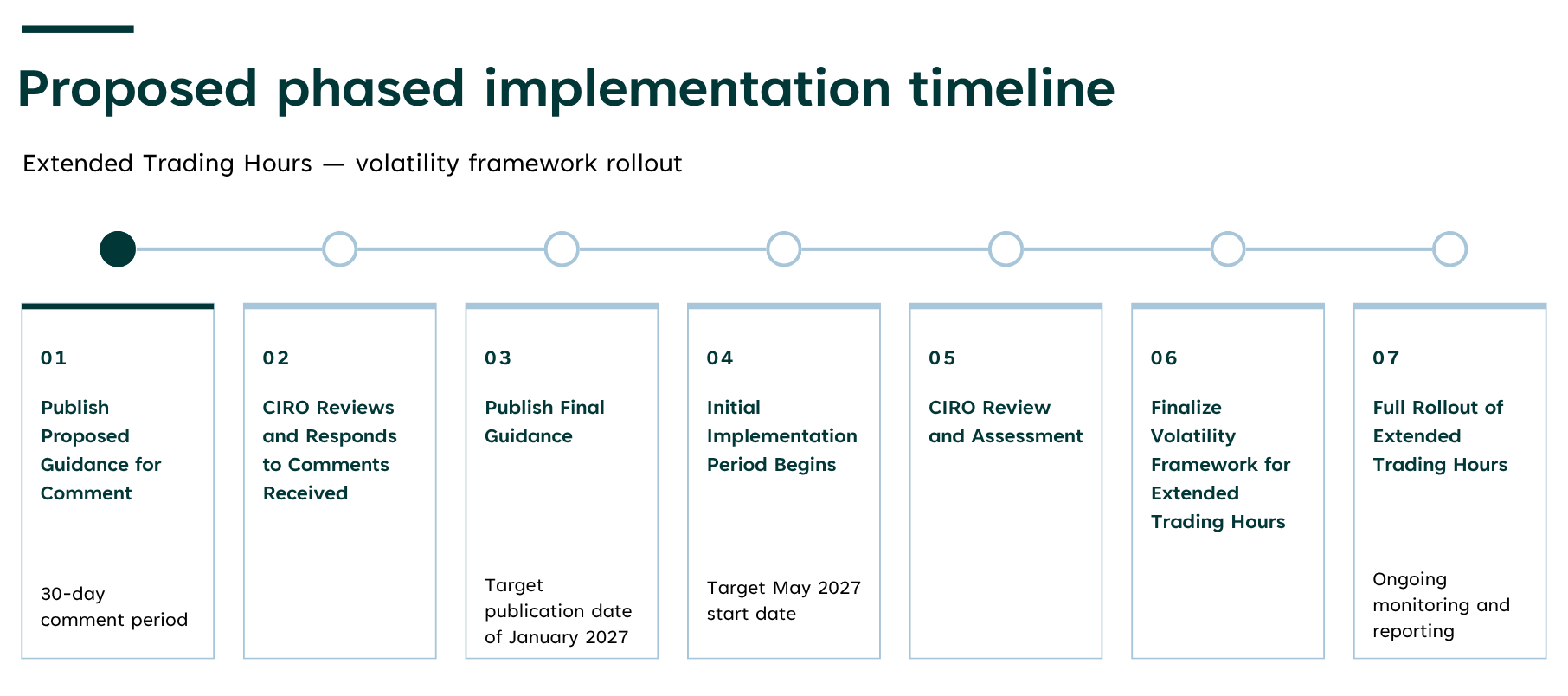
3. Phased Implementation
After considering the comments received in response to the Proposed Guidance, CIRO intends to publish final Guidance (Final Guidance), which would become effective 120 days following its publication. Once the Final Guidance becomes effective, the Initial Implementation Period would begin (Initial Implementation Period).
The Initial Implementation Period would allow CIRO to gather information on order and trade activity during extended hours and assess whether the proposed volatility controls are operating as intended. If CIRO determines that additional changes are warranted, CIRO would consider amendments to the Guidance on Marketplace Thresholds and the Guidance on Single-Stock Circuit Breakers as part of a subsequent phase.
4. Questions
While comment is requested on all aspects of the Proposed Guidance, comment is also specifically requested on the following questions:
Questions on Marketplace Thresholds and SSCBs
(a) Question 1 – Initial Implementation Period
(i) Effective date of Final Guidance
CIRO is proposing that the Final Guidance become effective no earlier than 120 days after publication to allow marketplaces to prepare for the Initial Implementation Period. In light of competing technology priorities, CIRO does not expect the Initial Implementation Period to begin before May 2027. If the Final Guidance is published after January 2027, would a minimum 120-day period provide marketplaces and other impacted stakeholders with sufficient time to complete any necessary technology, systems or operational changes?
(ii) Length of Initial Implementation Period
CIRO is seeking feedback on the appropriate length of time for the Initial Implementation Period. Data collected during the Initial Implementation Period would assist CIRO in reviewing order and trade activity during extended trading hours and assess whether further changes to the Marketplace Thresholds and SSCB frameworks are needed.
Questions on Marketplace Thresholds
(b) Question 2 - Data from Initial Implementation Period to be used for Assessment
CIRO recognizes that marketplaces currently take different approaches to address incoming orders that breach Marketplaces Thresholds as long as the execution of the offending order is being precluded. This can take one of the following forms:
- rejecting the incoming order
- repricing the incoming order, or
- booking the incoming order where there is no tradable liquidity on the other side and preventing any future execution of that booked order while it continues to fall outside Marketplace Threshold parameters.
To assist CIRO in assessing the appropriateness of the Marketplace Threshold price parameters during the Initial Implementation Period, CIRO is seeking information from marketplaces about orders that breach Marketplace Thresholds. This would include all orders that are rejected, repriced, or otherwise booked but not immediately tradable. For each such order, it would be helpful if marketplaces could include the following information:
- date and time of incoming order
- market order number (also known as the Sequence Number)
- symbol
- price
- volume
- National Last Sale Price (NLSP) and One-Minute Reference Price at the time the order was received by the marketplace
- identify whether the order was rejected, repriced, or booked (but not immediately tradable) on the marketplace.
CIRO seeks feedback from marketplaces on whether it would be feasible to provide a report containing this information to CIRO at the end of the Initial Implementation Period.
(c) Question 3 – Reprice One-Minute Reference Price to Opening Trade Price only
(i) Other trades resulting from an auction
CIRO is proposing the repricing of the One-Minute Reference Price only in the context of the Opening Trade2, and not in other instances such as any subsequent re-opening or closing auction later in the trading day. The reason for this proposal is that a new marketplace will now be open for a significant period of time prior to the listing exchange, which could contribute to a material difference between the pre-open trade prices and the calculated opening price on the listing exchange.
CIRO does not expect the same degree of potential price divergence during core trading hours, including in the case of a re-opening or closing auction, because the security would generally have been trading continuously throughout the day. Re-openings and closing auctions also occur under the current framework, and CIRO has not identified any material issues related to price divergence. Accordingly, to reduce operational complexity, CIRO is proposing to require the One-Minute Reference Price to be repriced only in connection with the Opening Trade.
CIRO seeks feedback on whether commenters agree with this proposed approach.
(ii) Implementation Impact of Repricing One-Minute Reference Price to Opening Trade Price
In order for marketplaces to reprice the One-Minute Reference Price to the Opening Trade price as proposed, marketplaces would need to:
- identify and consume the Opening Trade price from the listing exchange
- distinguish the Opening Trade from other auctions (e.g. reopenings and closing auctions) on a listing exchange.
CIRO seeks feedback on whether the above information is currently available from each of the listing exchanges as part of the market data feed in order to facilitate this implementation, and if not, whether this information may be made available by each of the listing exchanges.
(iii) No Opening Trade on Listing Exchange
In the event there is no Opening Trade on a listing exchange in a particular symbol due to limited liquidity, the first trade on the listing exchange would continue to establish the NLSP.
However, where the opening auction process on a listing exchange does not result in a trade, and the first trade on that exchange occurs later in the trading day during the continuous trading session (“first trade”), CIRO would not view that circumstance as presenting the same risk that needs to be addressed by the repricing requirement described above. Any difference between the price of that first trade on the listing exchange and prices on other marketplaces would generally be similar to the price variation that can occur during normal continuous trading. CIRO also notes that this scenario can occur today, without any corresponding obligation for marketplaces to reset the One-Minute Reference Price. Accordingly, CIRO is proposing that the requirement to reset the One-Minute Reference Price apply only in connection with the Opening Trades on a listing exchange.
CIRO seeks feedback on whether commenters agree with this proposed approach.
Question on SSCBs
(iv) Question 4 – Operation of SSCBs near opening
CIRO is proposing that SSCBs begin operating at 7:00 a.m. ET during extended trading hours, with wider trigger levels applying from 9:00 a.m. to 9:30 a.m. ET to account for potential volatility near the opening of the regular trading session. During this period, Marketplace Thresholds would continue to operate as the first layer of protection against erroneous orders and short-term unexplained price movements. For SSCB-eligible securities, the applicable Marketplace Threshold would remain at 10%, such that a single incoming order that would execute outside the applicable threshold would be rejected, repriced or otherwise prevented from executing.
Accordingly, under the proposed wider SSCB parameters, an SSCB would generally only be triggered during the pre-opening period where a series of orders causes the price of the security to move by at least 20% and 40 trading increments within five minutes.
CIRO seeks feedback on whether:
- Applying wider SSCB trigger levels appropriately balances the need to address potential volatility near the open with the objective of maintaining volatility controls during extended trading hours? In the event a SSCB is triggered near the open, there is a possibility of delaying the Opening Trade on the Primary Listing Exchange.
- SSCBs should continue to operate during the pre-opening period, rather than be suspended, during extended trading hours?
5. Appendices
Appendix A – Draft Guidance Note: Guidance on Marketplace Thresholds (clean)
Appendix B – Draft Guidance Note: Guidance on Marketplace Thresholds (blacklined)
Appendix C – Draft Guidance Note: Guidance on Single-Stock Circuit Breakers (clean)
Appendix D – Draft Guidance Note: Guidance on Single-Stock Circuit Breakers (blacklined)
- 1CIRO Bulletin GN-URPART1-25-0001 – UMIR – Primary Listing Exchange Designation (August 19, 2025).
- 2For the purposes of this Bulletin, an “Opening Trade” means the trade resulting from an “Opening Order” as defined under UMIR 1.1.
Under UMIR 1.1, an “Opening Order” is defined as an order for the purchase or sale of a security entered on a marketplace prior to the opening of trading on that marketplace on a trading day for the purpose of calculating and executing at the opening price of the security on that marketplace on that trading day provided an order shall cease to be an Opening Order if the order does not trade at the opening of trading of that security on that marketplace on that trading day.
Contact
Other Notices associated with this Enforcement Proceeding:
10/13/26
26-0210